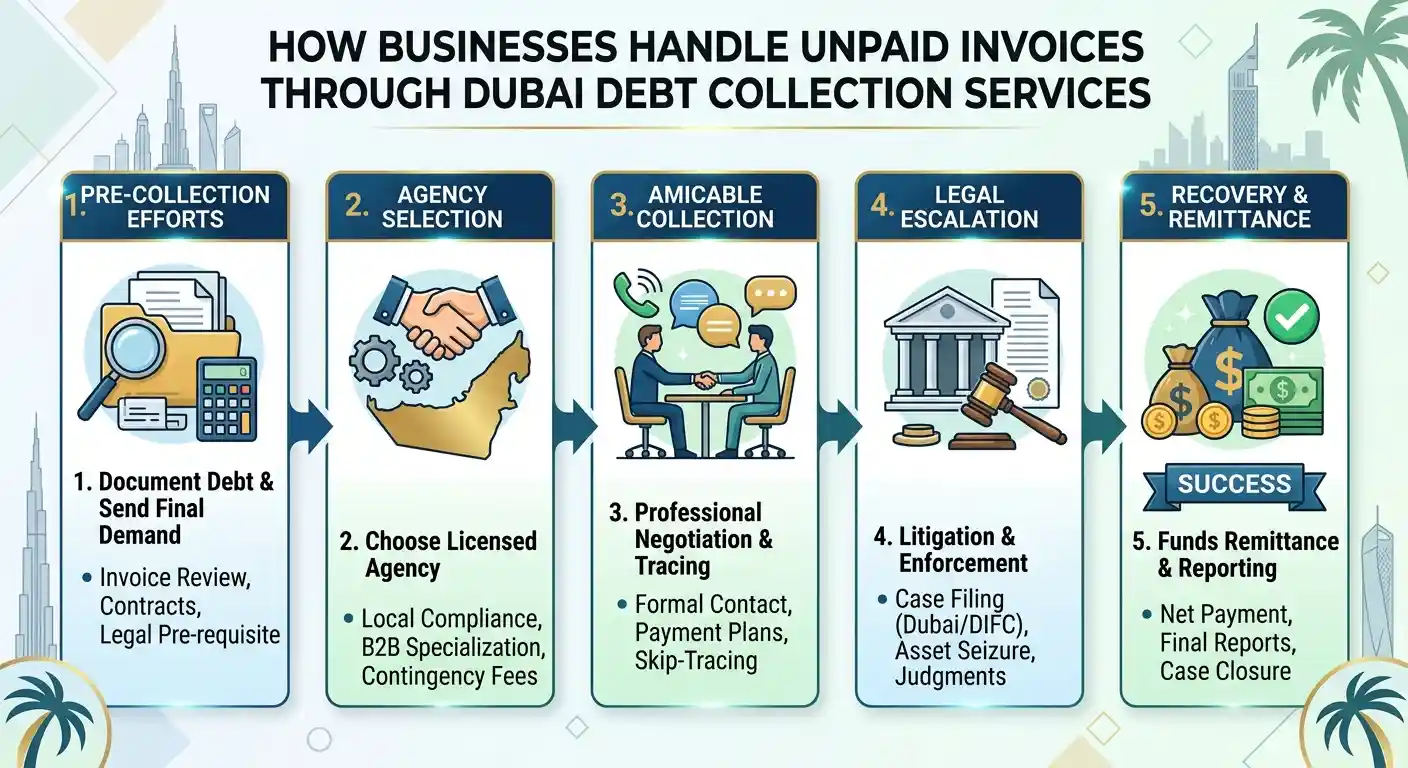
Unpaid invoices are a common challenge for businesses operating in Dubai. When customers delay payments for goods, services, or completed projects, companies may struggle to manage cash flow, pay suppliers, meet payroll obligations, and maintain daily operations. A structured approach to recovering outstanding invoices can help businesses protect their financial position while maintaining professional relationships with customers.
Debt collection Dubai services can help creditors review unpaid invoices, organise supporting evidence, communicate with debtors, negotiate repayment arrangements, and assess appropriate legal recovery options. The best approach depends on the amount outstanding, the contractual terms, the reason for non-payment, and the evidence available.
Businesses should understand their rights and responsibilities before taking recovery action. Acting promptly, maintaining accurate records, and following the applicable UAE legal procedures can reduce unnecessary disputes and improve the management of overdue accounts.
What Is an Unpaid Invoice?
An unpaid invoice is a payment request that remains unsettled after the agreed payment deadline. It may relate to products delivered, services completed, consultancy work, construction projects, maintenance agreements, or other commercial transactions.
For example, a Dubai-based supplier may deliver products to a customer under an agreement requiring payment within 30 days. If the customer fails to pay by the due date, the supplier may need to begin a structured recovery process.
However, an overdue invoice does not automatically establish that the entire amount is legally recoverable. The creditor may need to demonstrate that the goods or services were supplied as agreed, that payment became due, and that the claimed balance is accurate.


The debtor may also have a legitimate reason for withholding payment, such as incomplete work, defective goods, an agreed deduction, or a genuine disagreement about the contract. These issues should be reviewed before deciding on the next step.
Why Do Businesses Experience Invoice Payment Problems?
Late payments can arise for several reasons. Understanding the cause can help creditors choose a suitable recovery strategy.
Common reasons include:
- The customer is experiencing financial difficulties.
- The invoice was sent to the wrong department or contact.
- The customer disputes the quality or completion of the work.
- The parties disagree about the payment deadline.
- The customer claims that supporting documents are missing.
- The debtor is deliberately avoiding payment.
- The original agreement contains unclear payment conditions.
Some payment delays can be resolved through a simple reminder, while others require detailed document reviews or legal intervention.
Businesses should distinguish between a genuine administrative delay and a deliberate refusal to pay. This distinction helps determine whether informal communication, negotiation, or more formal action is appropriate.
What Should a Business Do When an Invoice Becomes Overdue?
An organised process helps businesses respond consistently when customers fail to pay on time.
- Review the Original Agreement
Start by checking the contract, purchase order, or service agreement. Confirm the agreed payment deadline, invoiced amount, payment conditions, and any contractual provisions concerning late payment or dispute resolution.
The creditor should also verify whether the invoice depends on a specific milestone, delivery confirmation, or customer approval.
- Confirm the Outstanding Balance
Review the company’s accounting records to establish the exact amount remaining unpaid. Consider previous payments, credit notes, refunds, agreed deductions, and any amounts already disputed.
An accurate balance reduces the risk of sending an incorrect demand and makes subsequent negotiations easier.
- Contact the Customer
Send a professional payment reminder identifying the invoice number, original due date, outstanding amount, and preferred payment method.
Ask the customer to confirm when payment will be made. If the customer disputes the invoice, request a clear explanation and any supporting evidence.
- Send a Formal Payment Demand
If reminders do not resolve the matter, a formal demand may be appropriate. It should explain the basis of the claim, identify the outstanding amount, specify a reasonable deadline where appropriate, and outline the potential next steps.
The required form and method of service depend on the contract, applicable legal rules, and the intended recovery procedure.
- Consider Legal Advice
If the debtor continues to withhold payment, the business may benefit from a legal assessment of the claim. A lawyer can review the agreement, supporting evidence, applicable deadlines, jurisdiction, and potential recovery options.
Seeking advice early can help identify weaknesses in the claim before further costs are incurred.
How Can Debt Collection Dubai Services Help Recover Unpaid Invoices?
Professional assistance can help businesses manage unpaid invoices systematically rather than relying on repeated, informal reminders.
Depending on the service provided, assistance may include reviewing contracts and invoices, organizing evidence, communicating with debtors, preparing formal correspondence, negotiating repayment arrangements, and evaluating potential legal proceedings.
A structured recovery strategy can also help businesses identify whether the debtor disputes the amount, requires additional documentation, or is experiencing genuine financial difficulties.
Where the claim cannot be resolved through negotiation, the creditor may consider an appropriate court procedure or another available legal remedy. The correct route depends on the circumstances and applicable UAE law.
Businesses should clarify the scope of any professional service, including fees, expected work, potential additional costs, and whether court representation is included.
No recovery service can guarantee that a debtor will pay or that legal proceedings will succeed.
What Documents Are Needed to Recover Unpaid Invoices?
Supporting evidence is essential when seeking payment from a customer who refuses to settle an invoice.
Businesses should organise the following records where relevant:
- Commercial agreements: Signed contracts, purchase orders, service agreements, and agreed terms.
- Invoices: Copies showing the amount claimed, issue date, due date, and transaction details.
- Delivery evidence: Delivery notes, shipping records, completion certificates, or customer acceptance records.
- Communication records: Emails, letters, and messages concerning payment or disputes.
- Accounting records: Statements showing payments received and the remaining balance.
- Acknowledgements: Written confirmation from the debtor that the amount is outstanding.
- Settlement proposals: Records of repayment offers or agreements previously discussed.
The creditor should ensure that the documents are consistent and that the amount claimed can be explained clearly.
If the transaction involves overseas parties, foreign-language records, or documents issued outside the UAE, additional questions about translation, authentication, and jurisdiction may arise.
Can an Unpaid Invoice Be Recovered Without Going to Court?
Yes. Many invoice disputes can be resolved through negotiation, direct communication, mediation, or a mutually agreed repayment arrangement.
An amicable resolution may be particularly useful when the creditor wants to preserve a long-term commercial relationship. For example, a customer facing temporary cash-flow difficulties may agree to pay the outstanding amount in instalments.
Any repayment arrangement should clearly identify the total debt, instalment amounts, payment dates, and consequences of missed payments. The parties should also clarify whether the original contractual terms remain in force or are being amended.
If the debtor does not honor the arrangement, the creditor may need to reconsider formal recovery options.
Businesses should evaluate settlement proposals carefully. Accepting a reduced payment or releasing a claim may affect their rights, so legal advice may be appropriate before agreeing to significant concessions.
What Is the Role of a Notary Public Dubai in Invoice Recovery?
A Notary public Dubai service may be relevant when a particular document connected with a commercial debt requires an eligible notarial act. However, notarization is not a substitute for the invoice recovery process.
Depending on the circumstances, a notary may be involved in formalizing certain declarations, signatures, or documents that are eligible for notarization under the applicable rules.
For example, a business may need a document formally executed for a related commercial matter or for use in another jurisdiction. The exact requirements depend on the document and the authority receiving it.
Notarization does not automatically prove that an invoice is correct, establish that the debtor owes the claimed amount, or guarantee enforcement.
For an ordinary unpaid invoice, the most important evidence will generally relate to the underlying transaction, contractual payment obligation, delivery or completion of work, and outstanding balance.
Businesses should confirm whether notarization is actually required before arranging the service. If the matter involves a formal demand, litigation, or enforcement, appropriate legal advice may be necessary.
Can Businesses Claim Additional Costs or Late Payment Amounts?
Whether a creditor can recover interest, contractual late-payment charges, legal costs, or other additional amounts depends on the agreement and applicable law.
A business should not automatically add charges to an unpaid invoice without checking whether the relevant contractual provision is enforceable and whether the amount is legally recoverable.
The creditor should review the agreement, the applicable legal framework, and any relevant procedural requirements before including additional sums in a demand or legal claim.
If the contract does not clearly address late-payment charges, the creditor should obtain legal advice before assuming that a particular amount can be claimed.
Keeping the principal debt separate from disputed additional charges can also help make the outstanding balance easier to understand and negotiate.
What Challenges Can Affect Invoice Recovery?
Several issues can complicate the recovery of unpaid invoices.
A debtor may dispute whether the goods were delivered, whether the work met the agreed specifications, or whether payment became due. Other challenges include incomplete contracts, missing delivery records, incorrect invoice details, or uncertainty about which court has jurisdiction.
Cross-border transactions can introduce additional issues involving governing law, contractual jurisdiction clauses, service of legal documents, and enforcement against assets in another country.
Businesses should also consider applicable limitation periods and other procedural deadlines. Waiting too long may affect the available remedies, depending on the circumstances.
A careful review of the claim before formal proceedings can help identify these risks and support a more informed decision.
How Can Businesses Prevent Future Invoice Disputes?
Preventive measures can reduce the likelihood of unpaid invoices and make future recovery easier.
First, establish written payment terms before supplying goods or services. Clearly define prices, deadlines, deliverables, acceptance requirements, and procedures for raising disputes.
Second, conduct proportionate credit checks before offering substantial credit to new customers.
Third, issue invoices promptly and ensure they contain accurate customer details, transaction descriptions, amounts, and due dates.
Fourth, retain proof of delivery, work completion, customer approval, and relevant communications.
Fifth, monitor overdue accounts and follow a consistent reminder process.
Finally, seek professional advice when a substantial invoice becomes disputed or a customer repeatedly fails to honor payment commitments.
Conclusion
Recovering unpaid invoices requires accurate documentation, clear communication, and a structured understanding of the available recovery options. Businesses should verify the amount owed, review the original agreement, contact the debtor, and consider settlement or legal action according to the circumstances.
Debt collection Dubai services can help businesses manage these steps, assess supporting evidence, and explore suitable recovery strategies. A Notary public Dubai service may assist with specific document formalities where required, but notarization alone does not establish a debt or guarantee payment.
By maintaining reliable records, setting clear payment terms, and responding promptly when invoices become overdue, businesses can better protect their cash flow and reduce the risks associated with commercial payment disputes.